A customer in Cardiff called me last spring because her garage door cable snapped — a door she’d had installed five years ago by another company. She assumed the door was defective.
It wasn’t defective. It was the salt.
If you live in a North County coastal zip code — 92007, 92024, 92054, 92075, parts of 92011 and 92008 — your garage door is aging on a different timeline than the same door in Escondido or Rancho Bernardo. Salt air is the reason, and it’s worth understanding because the fixes are simple and the savings add up.
What’s actually happening
Marine air carries microscopic salt particles inland on the coastal breeze — usually two to three miles, sometimes farther on windy days. Those particles settle on metal. When they meet humidity (and we have a lot of it), they form a salt-and-water film that accelerates corrosion. Not rust as you usually picture it, but a pitting, flaky oxidation that eats into steel from the surface in.
A few real numbers from doors I’ve serviced:
- A galvanized steel cable inland might last 18–20 years before the strands start fraying.
- The same cable in Cardiff or Encinitas: 7–10 years.
- A torsion spring inland: 15,000–20,000 cycles (about 12 years of normal use).
- A torsion spring in Solana Beach: 7,000–10,000 cycles (about 5–7 years).
These aren’t manufacturer defects. The doors aren’t built for coastal use unless you specifically ask.
What salt eats first
In order, from fastest to slowest to fail:
- Cables. Stranded galvanized steel. Salt gets into the gaps between strands. By the time you can see fraying, the cable has lost 30% of its load capacity.
- Torsion springs. Oil-tempered steel. Salt pitting creates stress concentration points. They snap, often without warning.
- Hinges and brackets. Painted or zinc-plated steel. The painted finish blisters and peels in 3–5 years.
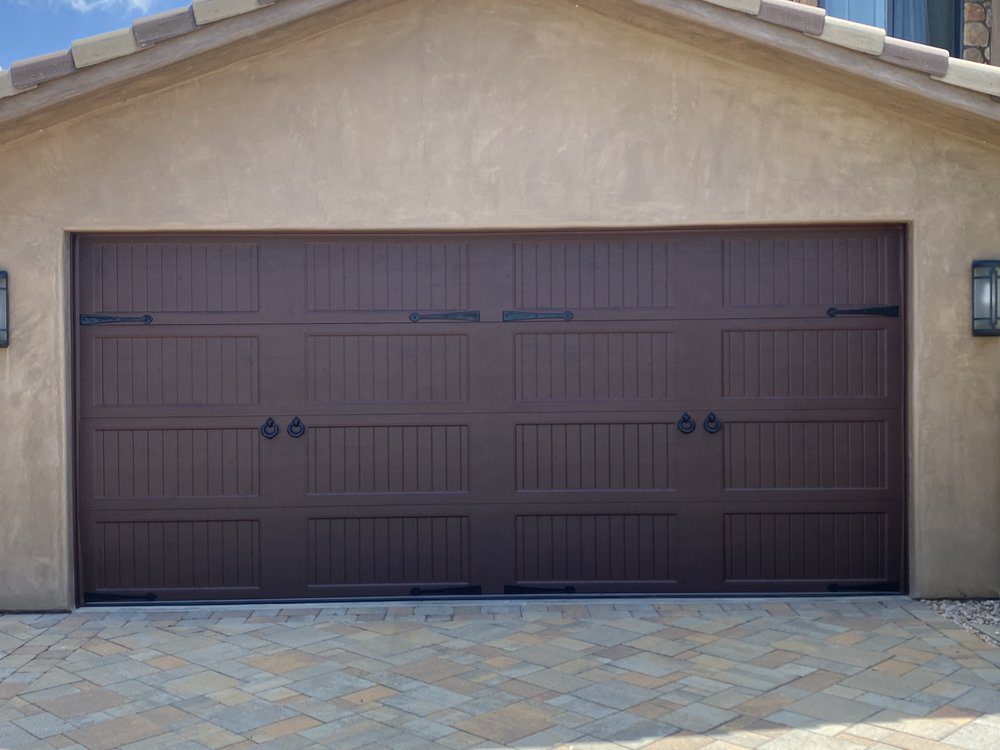
- Decorative hardware. Magnetic handles and hinges on carriage doors. Cheap powder coat is gone in two summers.
- Track. Galvanized steel. Lasts longer because there’s no constant load, but eventually rusts at the bottom where moisture pools.
- The panels themselves. Steel-faced doors with a baked-on paint finish hold up remarkably well — the paint is the protection. Once it chips, though, rust spreads fast.
The opener motor and electronics? Mostly fine. They’re inside the garage, away from direct exposure.
Are you in the danger zone?
Rough rule of thumb in North County:
- 0–½ mile from the ocean: maximum exposure. Plan on cable and spring replacements at half the inland lifespan.
- ½–2 miles: significant exposure. Lifespans about 70% of inland.
- 2–5 miles: mild exposure. Some hardware corrosion but main components last close to normal lifespans.
- 5+ miles inland: salt isn’t the issue. (Other things might be, but not salt.)
Cardiff, Leucadia, Olde Carlsbad, parts of La Costa, Solana Beach, Del Mar, and beachside Oceanside are all in zone 1 or 2.
What you can do
The good news is you don’t have to replace the whole door. A few targeted upgrades extend life dramatically:
1. Galvanized aircraft cable instead of standard. Doubles the corrosion resistance for about $35 in upgraded materials.
2. Galvanized torsion springs with a powder-coat finish. Standard springs are oiled bare steel. Galvanized + coated springs cost about $40 more per pair and last 50% longer at the coast.
3. Stainless or aluminum decorative hardware. Specifically for carriage doors with visible hinges and handles.
4. Annual lube + wipedown. Twice a year, give the whole door a once-over with a damp cloth and a fresh application of white lithium grease. This is the single biggest thing you can do to slow corrosion, and it’s free. Salt only does its damage when it’s left sitting on metal — wipe it off and it can’t.
5. Rinse the door. Once a quarter, hose the door down with fresh water (not a pressure washer — just a regular hose). Especially after windy days.
When to repair vs. replace
If you have a steel door under 10 years old and the panels look fine, repairs almost always make sense. New cables ($110), new springs ($330), and refreshed hardware ($150–$250) buys you another 7–10 years.
If the panels themselves are rusting through, the door is leaning, or you’ve got rust streaks running down the face from corroded hinges — that’s when full replacement starts to pencil out.
If you’re inland and your door is failing in 5–7 years anyway, something else is wrong. That’s an installation issue, a balance issue, or a defective batch. Different post.
I work all of North County, coast to inland, and I know what each zone does to a door. Happy to come look and give you an honest read — repair, refurbish, or replace. No commission, no rush.
Got a problem like this?
Call Mike directly. Most repairs done same-day.